Tell us about the job
Takes about a minute. No obligation.
A heat pump asked to carry a long heating season accumulates wear on the parts that work hardest in cold air: the reversing valve, the refrigerant circuit, and the coil that has to extract heat from outdoor temperatures that regularly drop toward freezing. Homes in Suffolk County, MA run heat about eight months a year, from October through May. Through those months, the compressor cycles against conditions where capacity is already reduced, and a unit that is undersized or losing refrigerant charge will show fault patterns a contractor can trace directly to that sustained load. When a repair call comes in, a contractor checks the compressor and the reversing valve first, because those are the components carrying the weight of the heating season.
Prewar ductwork has a particular shape to it: runs sized for gravity or early forced-air systems, modified at different points by different contractors, each round of changes leaving its own signature on what is reachable and what is sealed off. Half the homes in Suffolk County, Massachusetts were built in 1949 or earlier (2020-2024 ACS 5-year). When a heat pump in that stock needs repair, what the opened system shows a contractor is how many generations of adaptation sit between the original install and what is running now, and whether the parts the current unit takes have kept pace with any of it. A compressor or reversing valve that draws on a spec sheet from a previous equipment cycle may still be sourced, or it may not.
The Parts of a Heat Pump a Contractor Checks During Repair
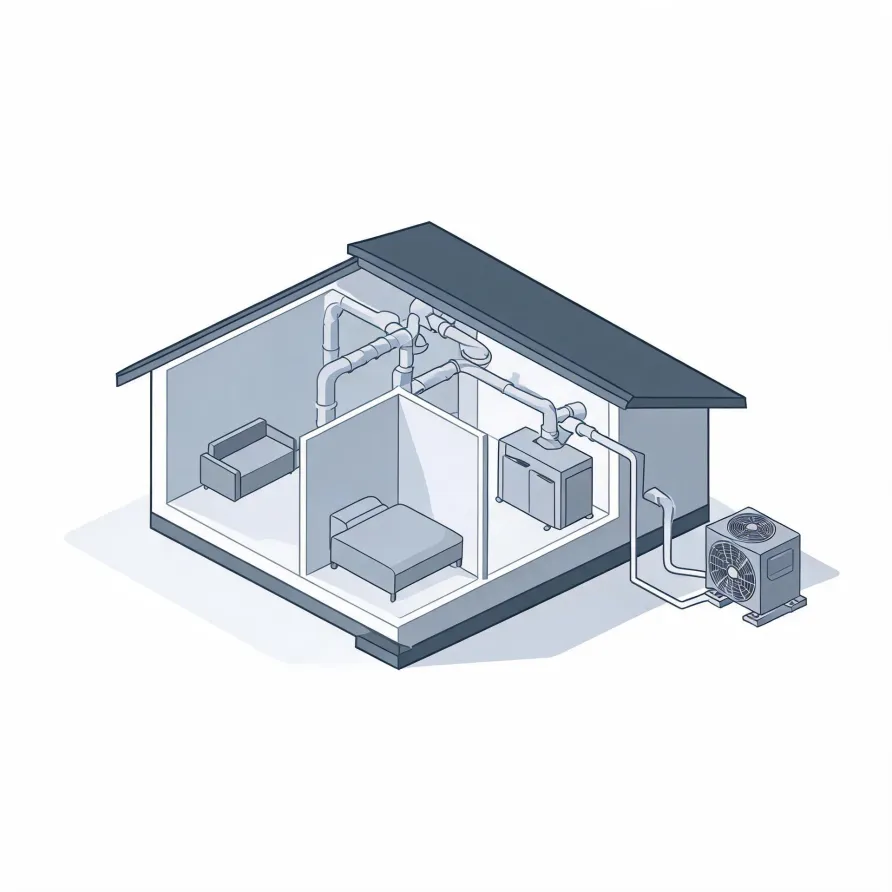
The outdoor unit sits on a pad beside the house and holds the compressor and condenser coil, which are the first places a contractor looks when the system stops heating or cooling properly. The compressor is usually the piece drawing the most attention: when it labors or fails, the whole system feels it. The condenser coil and its fan get checked alongside it.
Inside, the air handler mounts in a utility closet, basement, or attic and contains the evaporator coil and blower fan. The refrigerant lines run between the two units, and the reversing valve inside the outdoor unit is what lets the system shift between heating and cooling. Any of these can be the source of a fault.
The drawing shows the general layout of a heat pump system, and a licensed contractor determines which components are relevant to your specific house and situation.
Get matched in Suffolk CountySuffolk County, by the numbers
172 severe weather events were recorded in Suffolk County, Massachusetts between 2015 and 2024.
NOAA National Centers for Environmental Information, Storm Events Database, bulk CSV export, events 2015-01-01 through 2024-12-31.Half the homes in Suffolk County, Massachusetts were built in 1949 or earlier (2020-2024 ACS 5-year).
U.S. Census Bureau, 2020-2024 American Community Survey 5-Year EstimatesSuffolk County, Massachusetts holds 357,290 housing units (2020-2024 ACS 5-year).
U.S. Census Bureau, 2020-2024 American Community Survey 5-Year EstimatesOwners occupy 36.5% of the occupied homes in Suffolk County, Massachusetts (2020-2024 ACS 5-year).
U.S. Census Bureau, 2020-2024 American Community Survey 5-Year EstimatesLicensing, Code, and Repair Standards for Heat Pumps in Suffolk County, Massachusetts1 sourced rules and standards
Licensing and Legal Requirements in Suffolk County, Massachusetts
Massachusetts requires a state licence to work as a refrigeration technician, and to work as a pipefitter or sprinkler fitter.
Weather Stress on Heat Pumps in Suffolk County
Heat pumps work hardest when conditions outside are most demanding, and that workload shapes how quickly parts wear and when repairs come due. What the weather does in Suffolk County is a local fact, not a generic one, and the contractors here size their work to it.
172 severe weather events, 2015–2024. Source: NOAA National Centers for Environmental Information, Storm Events Database.